An international research team consisting of the Korea Astronomy and Space Science Institute, Kogakuin University, and Nagoya City University has conducted a detailed investigation of periodic lateral displacements observed in the jet launched from the supermassive black hole at the center of the giant elliptical galaxy M87. As a result, they found that these oscillations are not merely local fluctuations, but instead behave as “transverse waves” propagating downstream within the jet. Such waves may originate from activity in the vicinity of the black hole, or may be generated by instabilities that develop as the jet propagates. This discovery provides a new clue for understanding the physical processes occurring inside relativistic jets.
At the center of the giant elliptical galaxy M87 lies a supermassive black hole with a mass of about 6.5 billion times that of the Sun, from which a narrow and elongated relativistic jet is launched. Located at a distance of approximately 55 million light-years from Earth, M87 is an exceptionally important object that allows detailed observations of jet structures extending from the immediate vicinity of the black hole out to several kiloparsecs (Note 1). It is also widely known as the first object whose black hole “shadow” was imaged by the Event Horizon Telescope (EHT).
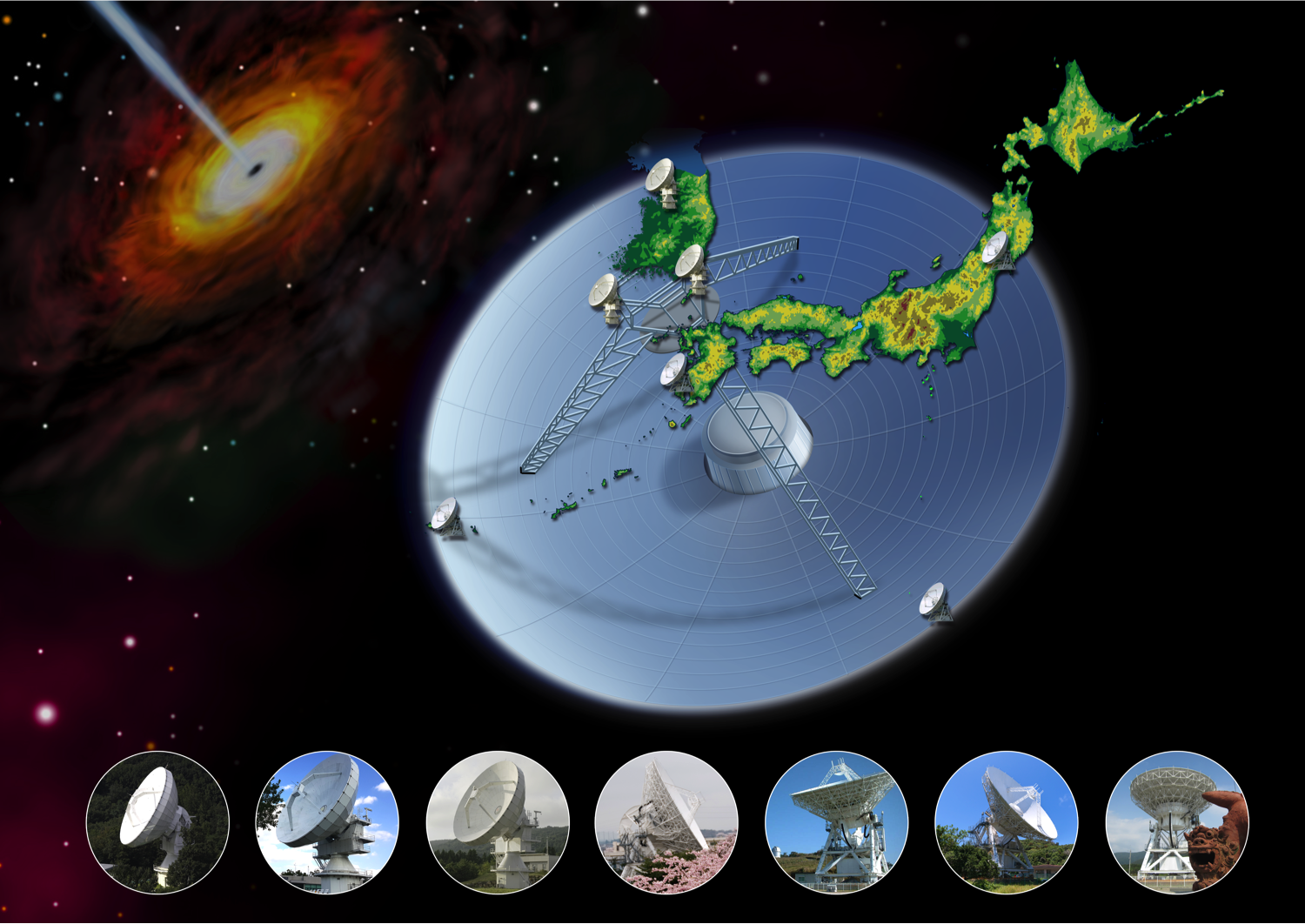
In this study, we performed a detailed analysis of the jet structure within 12 milliarcseconds (mas) (Note 2) from the central black hole using 22 GHz high-cadence monitoring observations (24 epochs from December 2013 to June 2016) obtained with the KaVA array (Figure 1), which combines Japan's VERA and Korea's KVN. This region corresponds to more than 1000 times the radius of the black hole. Previous studies had indicated the presence of small lateral oscillations with a period of about one year along the edges of the jet. Here, we investigated in detail how these oscillations evolve both spatially and temporally.
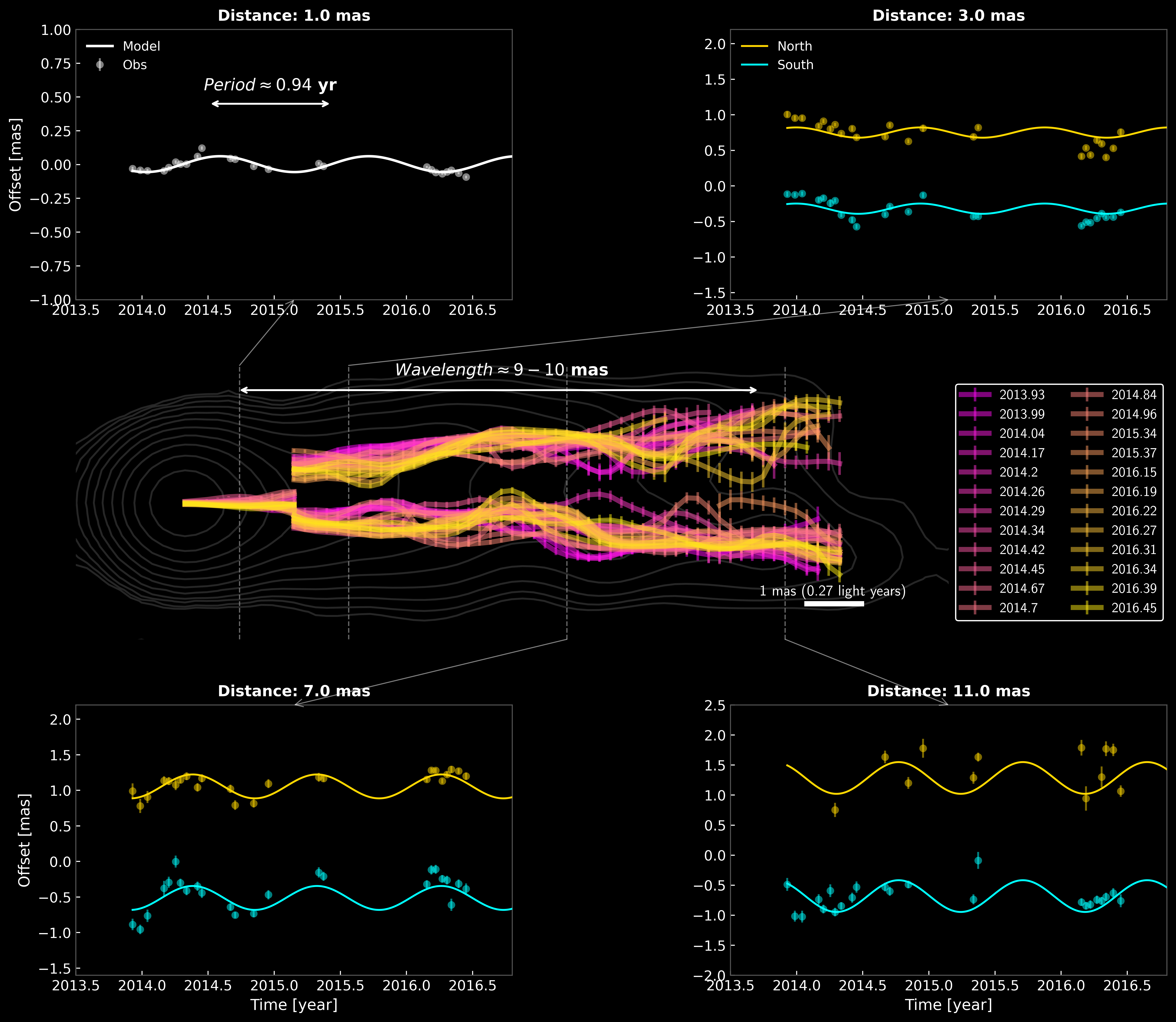
Our analysis reveals that these transverse oscillations are not simply local perturbations, but instead propagate downstream as coherent “transverse waves.” The oscillation period is nearly constant at about 0.94 years, and the phase advances continuously with distance. From the phase gradient, the wavelength of the transverse wave is estimated to be approximately 2.4-2.6 light-years (9-10 mas).
Furthermore, modeling the oscillation with a simple sinusoidal function shows that the apparent propagation speed of the wave reaches about 2.7-2.9 times the speed of light. This is an example of “superluminal motion” caused by relativistic effects, and does not imply actual faster-than-light travel. The fact that nearly identical periods and phases are observed on both sides of the jet suggests that this phenomenon has a coherent structure across the entire jet.
Several interpretations are possible for the origin of this wave. One candidate is an “Alfvén wave.” The M87 jet is thought to be dominated by strong magnetic fields, which may oscillate like stretched strings and transport energy. The observed wave speed is consistent with the expected properties of such magnetically driven waves. But where are these waves generated?
The most plausible origin is the immediate vicinity of the black hole. In this region, gas is expected to swirl violently, magnetic fields become twisted, and energy is released in a quasi-periodic manner. Such variability could excite waves that are launched into the jet. Indeed, a slower variation with a period of about 11 years has also been reported in the M87 jet, indicating the presence of multiple temporal rhythms. The jet appears not as a steady flow, but as a system “pulsating” across a wide range of timescales.
Another possibility is that the jet becomes unstable as it propagates, leading to the growth of distortions and fluctuations that travel downstream as waves. This can be likened to ripples forming on the surface of a flowing river. Future observations and theoretical studies are expected to clarify which mechanism plays the dominant role.
Dr. Hyunwook Ro, a postdoctoral researcher at the Korea Astronomy and Space Science Institute and lead author of the study, commented:
“This work provides the first clear evidence that waves with a period of about one year are actually propagating within a jet launched from a black hole. We are now working to improve sensitivity and resolution by combining the KaVA with radio telescopes in China and Italy, aiming to reveal time variability in regions even closer to the black hole.”
Associate Professor Motoki Kino of the Center for Promotion of Educational Innovation at Kogakuin University stated:
“The wave we detected has a period of about one year, but longer-period waves may also exist. To test this possibility, it is important to conduct long-term monitoring observations of the jet base in M87 using the East Asian VLBI Network.”
Associate Professor Kazuhiro Hada of Nagoya City University added:
“The East Asian VLBI Network is currently developing observations at 86 GHz. This will enable us to probe the jet base with even higher resolution and help clarify wave propagation in regions closer to the black hole.”
This work was published as “Transverse Oscillations and Wave Propagation in the Magnetically Dominated M87 Jet” by H. Ro, M. Kino, K. Hada et al. in The Astrophysical Journal on March 2, 2026. https://iopscience.iop.org/article/10.3847/1538-4357/ae355b
Notes
* (1) A parsec is a unit of distance used in astronomy; 1 parsec equals 3.26 light-years.
* (2) A milliarcsecond (mas) is a unit of angular measurement used in astronomy; in the M87 jet, 1 mas corresponds to 0.27 light-years.
Figure
[Figure 1] The KaVA (KVN and VERA Array), a joint Japan-Korea VLBI network. The lower panel shows the participating stations: Yonsei (Seoul), Ulsan, and Tamna (Jeju) of KVN, and Mizusawa, Iriki, Ogasawara, and Ishigaki of VERA. (Click to enlarge)
[Figure 2]
Central panel: Temporal evolution of the ridge line of the M87 jet brightness distribution (from December 2013 to June 2016). Gray contours represent the total intensity map. All images are rotated by 18 degrees clockwise so that the jet axis is horizontal. White arrows indicate the full extent of the transverse wave derived from ridge-line analysis, corresponding to about 2.4-2.6 light-years (9-10 mas). The apparent propagation speed of this wave reaches about 2.7-2.9 times the speed of light.
Surrounding panels: Transverse oscillations observed at distances of 1, 3, 7, and 11 mas from the core. Data points represent measured transverse displacements, while solid lines show the best-fit model. The horizontal axis is time (years), and the vertical axis is transverse displacement relative to the jet axis (mas). The oscillation period is approximately 0.94 years. (Click to enlarge)