A research team from the National Astronomical Observatory of Japan (NAOJ), Yamaguchi University, Ibaraki University, the University of Tokyo, Kyoto University, and other institutions monitored the supernova SN 2024iss for approximately one year using the Japanese VLBI Network (JVN). Radio emission was detected 10 and 23 days after the explosion. The observations indicate that the shock wave produced by the explosion was expanding faster than predicted by a standard theoretical model, suggesting that dense gas existed close to the progenitor star. This finding suggests that the star had a complex mass-loss history shortly before the explosion.
A supernova is an explosion that occurs at the end of the evolution of a massive star. Type Ⅱb supernovae are thought to originate from stars that have lost most of their outer layers before exploding. Gas released from a star spreads into the surrounding region and forms what is known as circumstellar material. When material ejected by the supernova collides with this circumstellar material, radio emission is produced. By studying how the radio brightness changes over time, astronomers can investigate how the progenitor star released gas before the explosion.
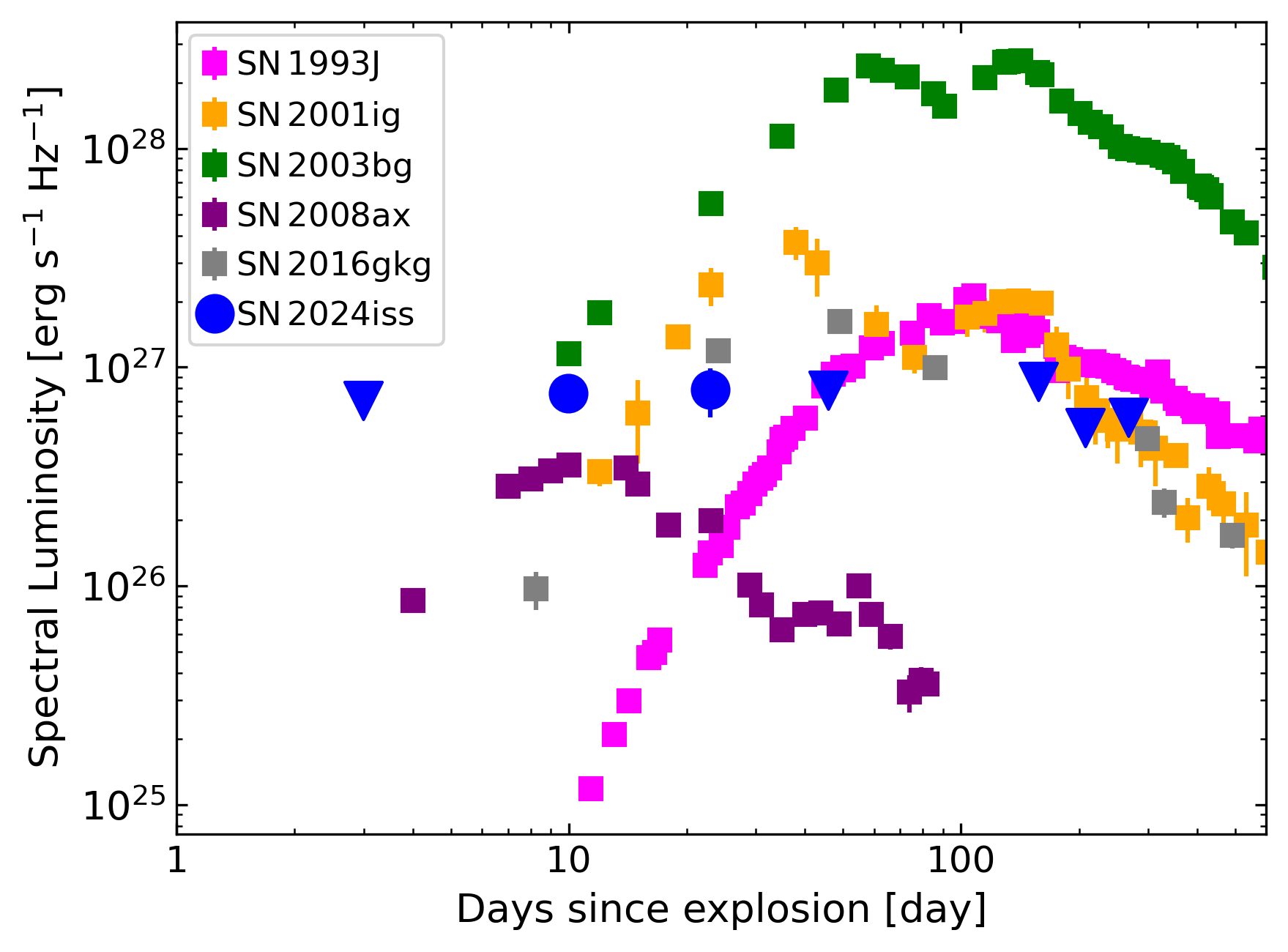
SN 2024iss is a Type Ⅱb supernova discovered on May 12, 2024, at a distance of approximately 46 million light-years from Earth. A research team led by Assistant Professor Yuhei Iwata of the Mizusawa VLBI Observatory, NAOJ, carried out nine JVN observations between 3 and 366 days after the explosion. The observations used the Hitachi 32-meter radio telescope operated by Ibaraki University and the Yamaguchi 32-meter radio telescope operated by Yamaguchi University. The team detected radio emission 10 and 23 days after the explosion, while no emission was detected in the later observations. These results show that the radio emission from SN 2024iss brightened relatively early compared with other Type Ⅱb supernovae.
The researchers also estimated the velocity of the shock wave from the radio brightness and the peak time. The estimated shock velocity was approximately twice the value predicted by a theoretical model in which the progenitor star had been losing gas at a steady rate. This difference may be explained if dense gas was concentrated very close to the progenitor and the shock wave accelerated as it emerged from this dense region. Separate X-ray observations have also suggested the presence of dense gas close to the progenitor. The new results therefore indicate that mass loss from the progenitor of SN 2024iss may have temporarily intensified shortly before the explosion.
The research team previously observed another Type Ⅱ supernova, SN 2023ixf, using a similar method. This is the second supernova from which the team has reported radio emission. Future observations of various types of supernovae are expected to provide further information about their progenitor stars. The high angular resolution of VLBI may also make it possible to directly resolve the expansion of material produced by these explosions.
These results were published on August 6, 2026, in the Publications of the Astronomical Society of Japan (PASJ) in a paper by Iwata et al. titled “Radio Constraints on the Circumstellar Environment of the Type Ⅱb Supernova SN 2024iss.”
Article Information
Yuhei Iwata, Tomoki Matsuoka, Masanori Akimoto, Keiichi Maeda, Nozomu Tominaga, Yoshinori Yonekura, Takashi J. Moriya, Kotaro Niinuma, and Kenta Fujisawa, “Radio Constraints on the Circumstellar Environment of the Type Ⅱb Supernova SN 2024iss,” Publications of the Astronomical Society of Japan, 2026
Acknowledgments
This work was supported by JSPS KAKENHI grant (JP23K13151, JP15H00784, JP23H04894, JP24KK0070, JP24H01810, JP26KJ0055), the National Science and Technology Council, Taiwan (MOST 110-2112-M-001-068-MY3, 113-2112-M-001-028-, NSTC 114-2112-M-001-012-), and the Academia Sinica, Taiwan (AS-CDA-111-M04). This work was partially supported by the inter-university collaborative project, the Japanese VLBI Network (JVN) of the National Astronomical Observatory of Japan.
Author List
- Yuhei Iwata(National Astronomical Observatory of Japan)
- Tomoki Matsuoka(The University of Tokyo, National Chung Hsing University, Academia Sinica)
- Masanori Akimoto(Yamaguchi University)
- Keiichi Maeda(Kyoto University)
- Nozomu Tominaga(National Astronomical Observatory of Japan)
- Yoshinori Yonekura(Ibaraki University)
- Takashi J. Moriya(National Astronomical Observatory of Japan)
- Kotaro Niinuma(Yamaguchi University)
- Kenta Fujisawa(Yamaguchi University)
Figure
Time evolution of the radio luminosity of SN 2024iss measured with the JVN (blue circles indicate detections, and downward triangles indicate upper limits from non-detections), compared with those of previously well-observed Type Ⅱb supernovae. SN 2024iss had a peak radio luminosity comparable to those of other Type Ⅱb supernovae, but became radio-bright at a relatively early phase.
Related information
- Ibaraki University
Radio observations of supernovae suggest gas release from the parent star just before its explosion.
- Yamaguchi University
Radio Observations of a Supernova Suggest Mass Loss from Its Progenitor Shortly Before the Explosion(Japanese Only)
- NAOJ Mizusawa VLBI Observatory
Radio Emission from a Supernova Observed with Japanese and Korean Telescopes