The SKA1 Subproject (SKAJ) at the Mizusawa VLBI Observatory of the National Astronomical Observatory of Japan (NAOJ), in collaboration with NEC Corporation, has successfully demonstrated a high-speed data transfer system, the Ultra-high-speed Data Transfer System (UDTS), as part of its joint evaluation efforts toward deployment. The system was installed at the Japanese node of the SKA Regional Centre Network (SRCNet) and evaluated through an ultra-long-distance data transfer experiment spanning approximately half the circumference of the Earth. The demonstration achieved stable data transfer rates several to tens of times faster than conventional approaches, demonstrating the feasibility of achieving the 100 Gbps-class international data transfer performance required by SRCNet.
SKAJ is promoting Japan's participation in the construction of the Square Kilometre Array Observatory (SKAO)-the world's largest radio interferometer currently under construction-through technical contributions, human resource development, and fundraising activities, thereby enabling the Japanese research community to fully exploit its scientific capabilities. In parallel, Japan plays an important role in the development of SRCNet, a distributed global data infrastructure for providing approximately one exabyte of observational data generated every year by SKAO. SRCNet consists of a federation of data centres distributed around the world and requires data transfer performance of 100 Gbps between the SKAO and its regional data centres.
Achieving high-speed data transfer over long-distance networks is challenging. End-to-end performance can be constrained by many factors, including storage performance, the processing capabilities of CPUs and network devices, information security measures such as firewalls, the routing of transcontinental optical fiber networks, and network latency. As a result, actual data transfer speeds are commonly well below the maximum capacity of the network links.
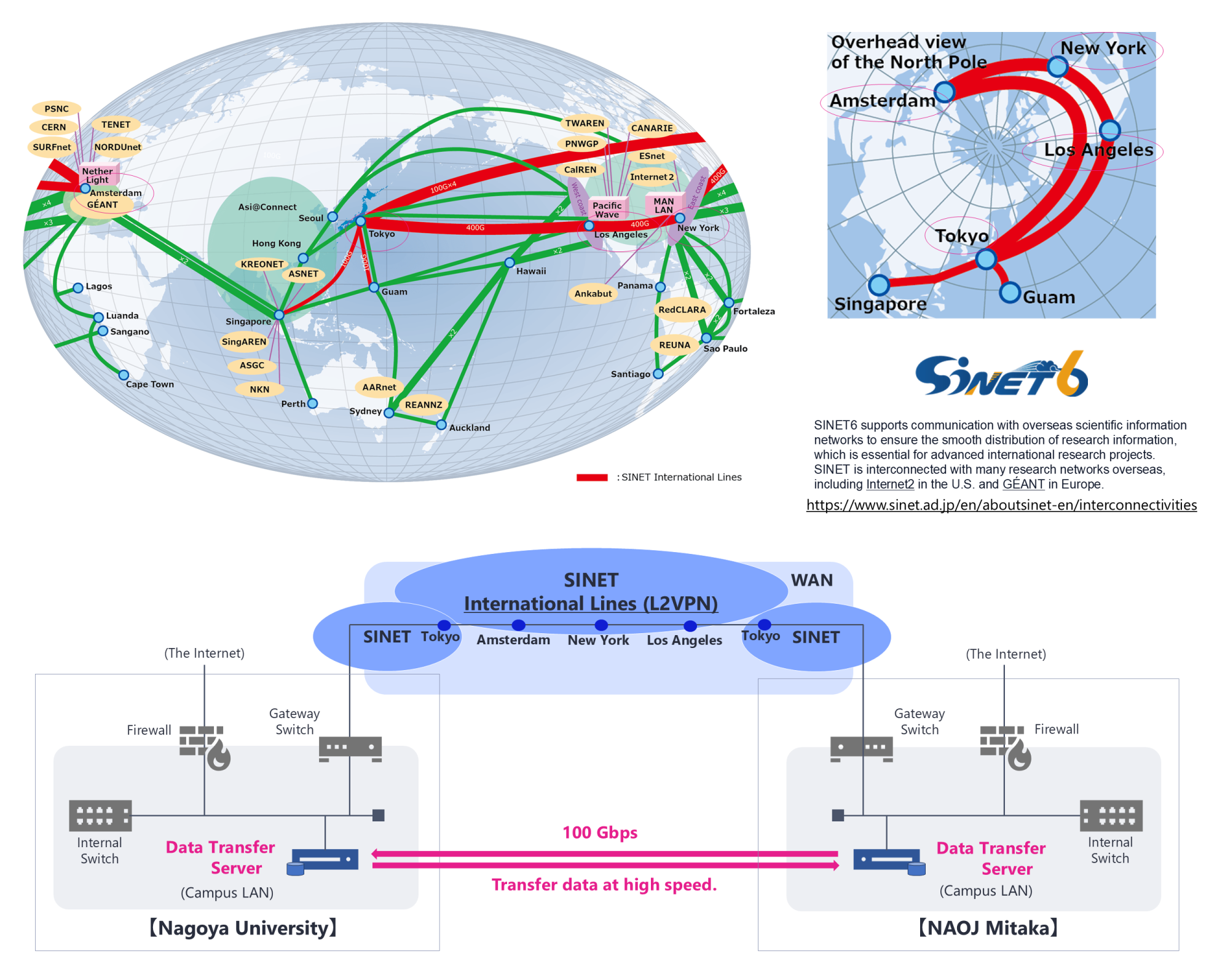
In this demonstration, UDTS was deployed at Nagoya University and at NAOJ’s Mitaka Campus. An L2VPN was established using the international links of SINET, Japan’s academic network operated by the National Institute of Informatics (NII), creating a network path connecting Nagoya–Tokyo–Amsterdam–New York–Los Angeles–Tokyo–Mitaka. The total length of this network path was comparable to the circumference of the Earth. Large-volume data transfer tests at a scale representative of that envisioned for SKAO were conducted in this intercontinental network environment, where the round-trip time (RTT) exceeded 400 milliseconds.
The experiments demonstrated that both the conventional data transfer methods and that currently under consideration for SRCNet exhibited unstable performance depending on file size, file count, and user concurrency. Even under their best-performing conditions, these protocols were unable to fully utilize the available network bandwidth. In contrast, UDTS consistently achieved near line-rate throughput, almost fully utilizing the available network bandwidth regardless of file size, the number of files transferred, or the number of simultaneous users.
These results demonstrate that an integrated system capable of meeting SRCNet's 100 Gbps-class international data transfer performance requirement is achievable with UDTS, providing strong momentum toward the realization of the global SRCNet infrastructure. Future work will include interoperability tests with SRCNet nodes in other countries and demonstrations using an environment compliant with the SRCNet file transfer workflow, with the ultimate goal of deploying UDTS as part of the operational SRCNet infrastructure.
This work was carried out in part using SINET, the academic information network constructed and operated by the National Institute of Informatics (NII).
Principle Investigator
- Kazuyoshi Yamashita, Senior Specialist, Square Kilometer Array 1 (SKA1) Promotion Group, Mizusawa VLBI Observatory, National Astronomical Observatory of Japan (NAOJ)
Co-Authors
- Takuya Akahori, Associate Professor, Square Kilometer Array 1 (SKA1) Promotion Group, Mizusawa VLBI Observatory, National Astronomical Observatory of Japan (NAOJ)
- Kiyotomo Ichiki, Professor, Graduate School of Science, and Kobayashi-Maskawa Institute for the Origin of Particles and the Universe (KMI), Nagoya University
- Hajime Shimada, Associate Professor, Information Technology Center, Nagoya University
- Yosuke Taira, Senior Manager, NEC Corporation / NEC Deutschland GmbH
Figure
Top: Overview of the SINET6 international links used in this demonstration. The data transfer followed a route connecting Tokyo, Amsterdam, New York, Los Angeles, and Tokyo(Source: Adapted from NII SINET6 materials.). Bottom: Network configuration of the demonstration. Data transfer servers installed at Nagoya University and the NAOJ Mitaka Campus were connected via a SINET L2VPN to perform high-speed data transfers between the two sites.
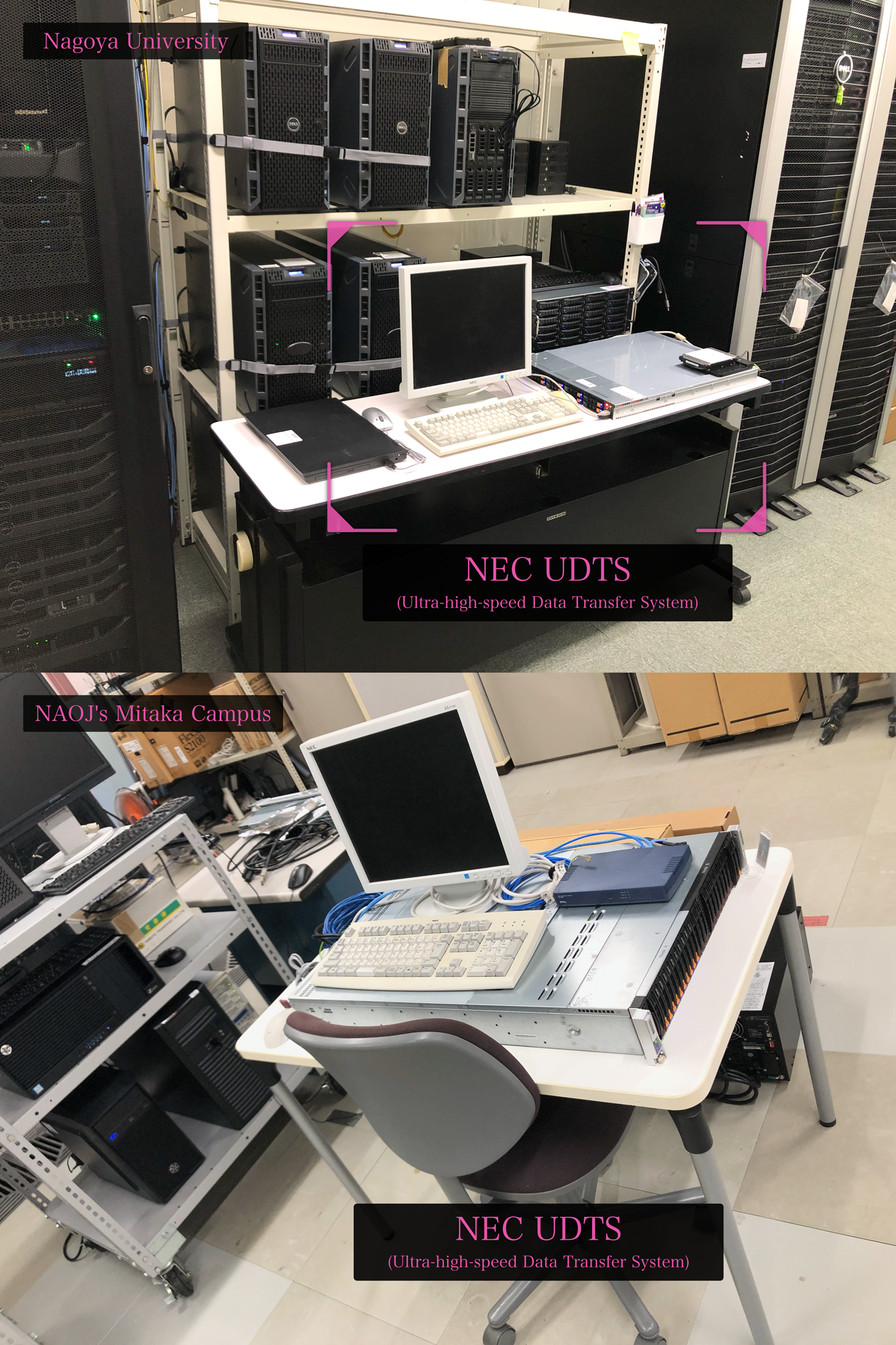
The NEC UDTS servers installed at Nagoya University and the Mitaka Campus of the National Astronomical Observatory of Japan (NAOJ). The two sites are connected via a 100 Gbps SINET L2VPN, over which high-speed data transfer tests were conducted between the servers.