
We can measure slow movements of tectonic plates covering the Earth's surface
with space geodetic techniques, in which we perform precise measurements over
the reference frame composed of celestial bodies. Past observations have
revealed that the velocities of such plates are uniform in timescales ranging
from a few millions of years. In subduction zones, convergent movements of the
two adjacent plates take place as inter-plate earthquakes at deep-sea trenches.
However, the numbers and magnitudes of the actual earthquakes have been pointed
out to fall seriously short of those predicted by the plate velocities.
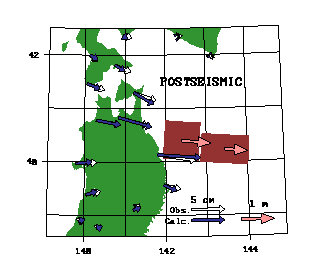
By analyzing the data of nationwide permanent Global Positioning System (GPS)
array over a one year period after the 1994 Dec. 28 Sanriku-Haruka-Oki
earthquake (moment magnitude 7.6), researchers in National Astronomical
Observatory and Geographical Survey Institute found that GPS points in the
Northeastern Japan have undergone slow eastward movements lasting for a year
after the earthquake as well as the jumps at the time of the earthquake
occurrence. This suggests possible existence of silent (i.e. without
earthquakes) fault slip as large, in energy, as the high-speed rupture that
caused damages over the wide area around Hachinohe-city. Such a slow fault
slip that is difficult to be detected by conventional seismometric
observations, might be taking up the deficiency of seismic slips along the
deepsea trenches.
(K. Heki)

